Is your equipment HSE GS38 compliant?
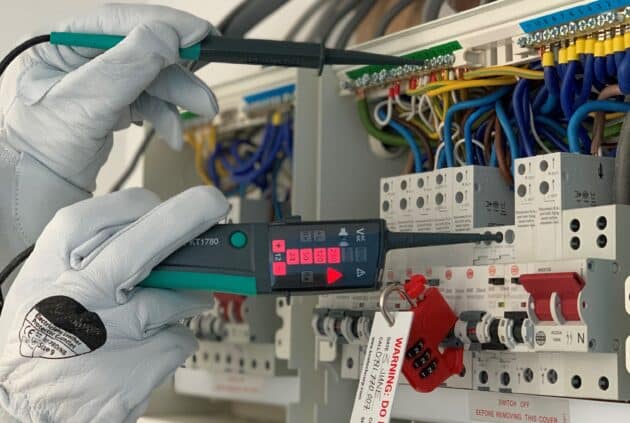
You may wish to consider the following advice when selecting and using test equipment when working on Low Voltage (LV) electrical installations.
This advice is provided for consideration as part of your risk assessment and method statement, derived from the site-specific risk assessment.
HSE Guidance Note GS38 (Fourth Edition) is the UK Health & Safety Executive’s safety requirements for Electrical test equipment for use on low-voltage systems. Testing equipment and accessories that conform to these standards are designed to minimise the risk of electric shock, arcing, and injury when working on low-voltage electrical systems (up to 1000 V AC / 1500 V DC).
It is imperative that your test equipment conforms to the standards set out in HSE GS 38 to prevent accidental contact, reduce shock risk, and ensure equipment can safely handle faults.
Whether you are following the correct safe isolation procedure to prove dead, or fault-finding on a live circuit, you should ensure that the equipment conforms with the requirements set out in HSE GS38.
GS38 applies to electrical test equipment such as:
- Test probes;
- Leads;
- Lamps;
- Voltage detecting devices; and
- Measuring equipment; for circuits with rated voltages not exceeding 1000V AC.
6 things to look out for…
GS38 checklist:
-
Use shrouded or insulated tips
Probes should be insulated to leave an exposed tip not exceeding 4mm measured across any surface tip of the probe. Where practicable, it is strongly recommended that this be reduced to 2mm or less, or that spring-loaded retractable screened probes be used.
Warning: We strongly recommend not using any test leads or test probes which have removable tips. In the likely event that you lose or misplace these tips, the probes may no longer be GS38 compliant, having more than 4mm exposed.
-
Have finger guards
Finger guards on your two-pole testers and probe tips stop your fingers from slipping onto live parts during use.
-
Use high-integrity insulated leads
Your test leads should be double-insulated, such as Kewtech’s G7 precision standard test leads. We would strongly recommend using silicone-insulated leads as these are more durable, flexible and heat-resistant.
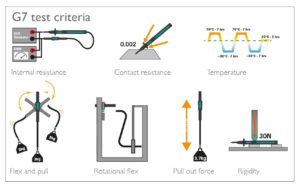
Kewtech’s G7 test lead testing criteria
-
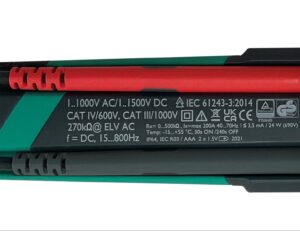
CAT rating
Match the equipment to its environment:
- CAT II – (Prospective short circuit currents are less than 10kA), for example, appliances and single-phase domestic installations
- CAT III – (Prospective short circuit currents of up to 50kA), for example, testing of 3-phase installations, distribution boards, wiring systems, equipment and socket outlets connected to 3-phase systems.
- CAT IV – (Where prospective fault currents may exceed 50kA, for example, at the origin of installation that are close to HV/LV transformers or where there is risk of high energy arc flashes).
For most electrical testing on LV systems, a minimum of CAT III or CAT IV is recommended.
-
Be robust and properly maintained
Be vigilant. Regularly check your equipment to ensure it is fit for purpose. There should be no exposed metal parts other than probe tips and no visible inner insulation on the test leads.
Carefully look for damage, deterioration and the presence of water or other liquids that may be present before each use. Check the function of the test equipment on a proving device or known live source before use.
-
Use a reputable brand that manufactures and conforms to the relevant British Standards.
Look for the manufacturer’s declaration of conformity with HSE GS38 and verify that the probes, leads, and tester are all compliant, not just the measuring unit.
Further recommendations to consider:
-
Working without batteries?
Consider the use of a voltage indicator that will still indicate the presence of voltage without batteries or even when the batteries fail. Battery-dependent testers introduce an additional point of failure, and a flat or faulty battery could give a false indication. Contrastingly, products that are self-powered from the circuit under test, or that incorporate battery-independent voltage indication, provide an added layer of reliability.
-
Single-Pole Detection
Equipment that offers single-pole detection can provide an extra safeguard by allowing the presence of voltage to be identified with reference to earth, which may highlight hazardous conditions not always apparent with two-pole testing alone.
-
Non-detachable leads
Equipment with permanently fixed leads should also be strongly considered. Detachable leads present a risk of poor connections, damage, or the inadvertent use of non-compliant accessories, whereas fixed leads reduce the likelihood of misuse and help to maintain GS38 compliance over the life of the tester.
The Bottom Line
Ensuring your electrical test equipment is HSE GS38 compliant is not just best practice—it’s a critical part of managing risk when working on low-voltage systems. By selecting the right equipment, checking it is suitable for the environment, and maintaining it properly, you significantly reduce the risk of electric shock, arcing, injury and danger to life. GS38 compliance should be a fundamental consideration of your working, helping to protect yourself and others as well as the installations while promoting safe, professional working practices.
More News Articles