Single-Pole Voltage Indicators: Why They Matter

Single-Pole Voltage Indicators: Why They Matter
In our previous article, “Test Before Touch,” we highlighted the growing risk of dangerous surface voltages appearing on metalwork such as pumps, motors, and boiler casings. These hidden hazards can be lethal if not detected.
Single-pole voltage detectors—like Kewtech’s KT1700—are commonly used to check for the presence of voltage. While they don’t provide a full diagnostic, they offer a critical warning that a dangerous potential may exist. This is especially important in scenarios such as a PEN fault, where all conductors could sit at the same potential. In these cases, a two-pole BS EN 61243-3 voltage indicator might fail to reveal the danger, but a single-pole device can give that life-saving alert.
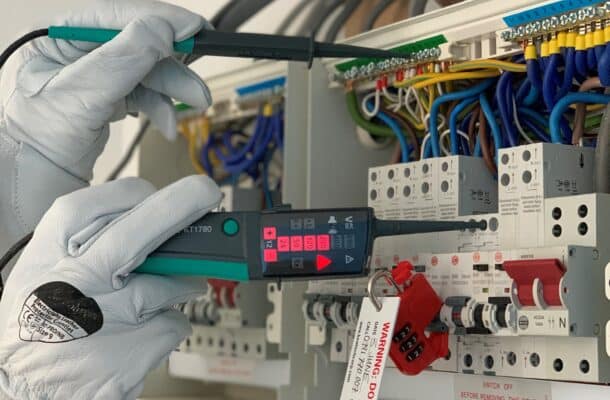
Here’s the good news: Kewtech’s range of two-pole voltage detectors—including the KT1710, KT1780, KT1795, and KT5—also function as single-pole detectors. Simply use the main probe (the one with the voltage display) to touch any metallic surface. If a hazardous voltage of 100V or above is present, you’ll know instantly.

KT1780 in single pole use to indicate hazardous voltage.
This means you get a voltage detector that not only meets UK legislation for proving dead but also gives engineers extra peace of mind—allowing you to Test Before Touch without buying a separate device.
Remember: Test Before Touch. It could save a life.
Andy Griffiths, GCS Doncaster, in partnership with Kewtech.

More News Articles

31 Mar 2026
At Kewtech, support is just part of the package.
23 Mar 2026
The tester everyone is talking about
23 Feb 2026
Stop using your Multimeter for proving dead!